




Embark on a journey to discover the fascinating world of school buses. Despite their shared iconic yellow school buses, a symbol of safety and visibility, school buses exhibit a remarkable array of designs and sizes. From the compact, van-like models to the coaches, each type of school bus presents its unique characteristics. All are bound by a common thread: compliance with Federal Motor Vehicle Safety Standards (FMVSS), which govern everything from crashworthiness to conspicuity features.
This guide by our team at Infinity Transportation will delve into the various types of school buses, exploring how each design caters to specific needs and environments, and the critical safety features that unify them under the banner of student transportation.
The Main Types of School Buses
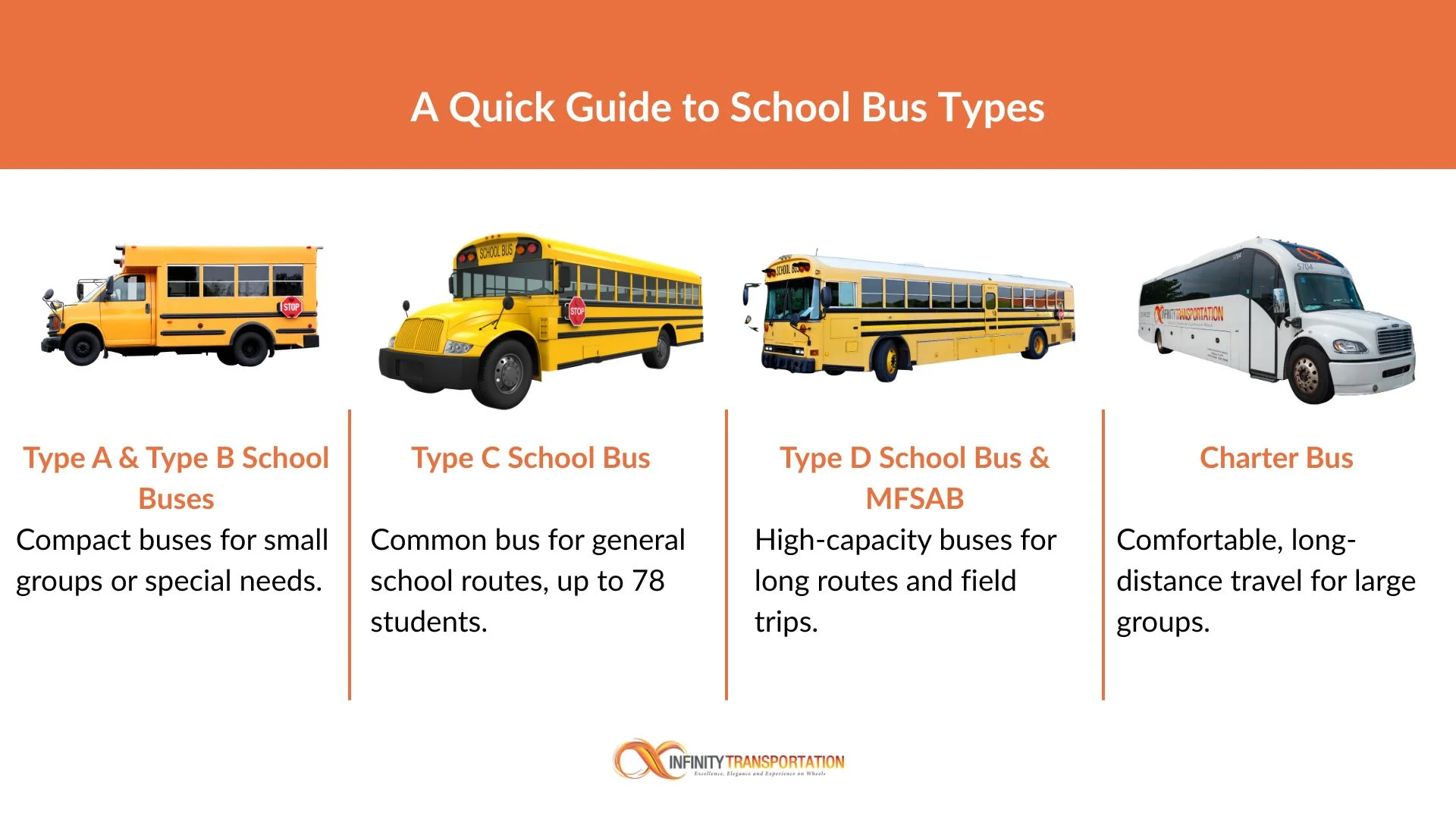
School buses in North America are systematically categorized into four primary types each defined by its chassis, engine placement, and gross vehicle weight rating (GVWR). This classification system, alongside FMVSS, ensures a consistent baseline for safety and operational characteristics.
10 to 30 passengers

Type A school buses are categorized into two sub-groups: Type A-1 and Type A-2. These buses are constructed using a cutaway front section vehicle, featuring the left-side driver's door. Type A-1 school buses have a gross vehicle weight rating (GVWR) of less than 10,000 lb, while Type A-2 school buses boast a GVWR of 10,000 lb or more. The GVWR signifies the maximum allowable weight of the bus when fully loaded, encompassing passengers, fuel, and other cargo. These buses typically carry 10 to 30 passengers and are often chosen for special needs transport due to their small size and adaptability.
Notably, some Type A school buses introduced in 2004 were designed with a GVWR of 14,000 lb, allowing them to transport more than 10 passengers on board. Drivers operating Type A buses must hold a commercial driver's license (CDL) with a school bus and "P" (passenger) endorsement.
Up to 38 passengers

Type B school buses are designed to carry more than 10 passengers and have their bodies attached to a front-section vehicle chassis after construction. These buses typically have a gross vehicle weight rating of more than 10,000 lb. A unique design element of Type B buses is that part of the engine is mounted partially inside the passenger compartment, often beside the driver's seat and behind the windshield.
The entrance door for students is positioned behind the front wheels. Though less common today, Type B buses are still selected for districts with specific school district needs or route-matching challenges. Drivers of Type B buses must have a CDL with a Type B School Bus endorsement.
Up to 78 passengers

The Type C bus is the most widely used school bus design across North America. Type C bus is recognized as the classic school bus design, characterized by its chassis with a hood and front fender assembly. These buses feature an entrance door positioned behind the front wheels. In addition to the traditional design, Type C buses encompass cutaway truck chassis or truck chassis with cabs, some with a left-side door and some without.
These buses have a gross vehicle weight rating (GVWR) exceeding 21,500 lb. Type C school bus manufacturers build these buses to accommodate more than 10 passengers, so they're a prevalent choice for safely transporting students. They typically carry 54 to 78 students, making them a fleet staple for general routes thanks to their balance of capacity, maneuverability, and easy front-engine maintenance.
Up to 90 passengers

Type D vehicles, also referred to as "Transit-Style" buses, are purpose-built to carry more than 10 passengers. These vehicles come with engines situated behind the windshield and beside the driver's seat, and they can be categorized into two types: forward engine (FE) buses and rear engine (RE) buses, depending on the engine's location. In the case of RE buses, the engine is positioned behind the rear wheels. These transit-style vehicles are recognized for having entrance doors placed in front of the front side wheels.
Notably, Type D buses typically boast a gross vehicle weight rating exceeding 10,000 lb, often falling within the range of 25,000 to 36,000 lb. These vehicles are equipped with both front and rear axles to support their structure and can extend up to a maximum length of 45 feet. Type D school buses can transport up to 90 students, making them the highest capacity option, best suited for districts with high student populations, longer routes, or situations requiring maximum efficiency in student transport.
Beyond the Standard: Specialized School Vehicles
While the A-D classifications cover the primary types of school buses, districts also utilize other vehicles to meet unique transportation needs.
Capacity varies

Multifunctional School Activity Buses (MFSABs) are vehicles used by schools for purposes other than student transportation and aren't required to be painted in traditional yellow. They are not permitted for daily home-to-school transport but are ideal for field trips, sports events, or offsite programs. MFSABs don't require stop arms or flashing lights, but they must meet school bus crash avoidance, post-crash standards, and conspicuity standards for safety.
Up to 10 passengers

School vans are typically regular vans that have been modified to meet bus requirements for schools. Alterations may include increasing the van's height by cutting the roof and welding a full roll cage into the body. Once these modifications are made, the van can be operated like a regular transportation vehicle while complying with all standards set by the Motor Vehicle Safety Department. School vans are designed to carry 10 passengers, including the operator.
School Buses for Students with Special Needs
School buses for students with special needs are often modified Type A or Type C models, equipped with wheelchair lifts, securement systems, and climate control. Interiors may include wider aisles, flexible seating, and space for aides or medical equipment to ensure safe, comfortable, and dignified transport.
These vehicles play a crucial role in fulfilling the transportation requirements outlined in Individualized Education Programs (IEPs) and complying with the Americans with Disabilities Act (ADA).
Allowable Alternate Vehicles
These vehicles provide alternative options to conventional school buses and offer diverse designs and features while still prioritizing the safety of students during transit. Infinity Transportation offers a large fleet of motor coaches and charter buses, each with its particularities. Here are some of the most popular forms of bus rental for student transportation services.

If the thought of traveling in a coach bus gives you cold sweat at the memories of long trips in uncomfortably cramped quarters, think again: bus transportation has come a long way. Nowadays, a coach bus is one of the most comfortable forms of transportation for large groups for extended traveling — a key difference when comparing a charter bus vs. school bus.
Our 54-passenger and 57-passenger coach buses offer spacious, high-capacity travel with reclining seats, tinted windows, and ample luggage storage. The 54-passenger model includes standard comforts like air conditioning, PA systems, and optional restrooms, while the 57-passenger version adds leather seating, seatbelts, Bluetooth, and wood flooring — ideal for long trips, athletic events, or large group outings.
Coach Buses

If you're looking for the same comforts as the ones offered in a full coach bus but only need student transportation services for a small group of individuals, a coach charter is the perfect solution.
Our 32-42 passenger coach buses deliver a premium experience in a compact size, with leather reclining seats, wood flooring, ample storage, climate control, USB outlets, PA systems, and Bluetooth — ideal for medium-sized groups needing comfort and efficiency.

If you're looking for transportation for students in small groups and want to keep prices low – both for fuel and rental costs – while maintaining a certain level of comfort, then a minibus rental is the perfect compromise.
Our luxurious minibuses are just as comfortable as their large coach counterparts. They have a capacity of up to 22 students and include amenities such as comfortable leather seats, USB outlets, air conditioning, and rear and overhead storage for any extra belongings or equipment.
Our 20/22-passenger ADA-compliant minibuses combine accessibility and comfort, with space for one or two wheelchairs, integrated lifts, and amenities like leather reclining seats, PA systems, entertainment options, USB ports, and overhead storage, offering inclusive, high-quality transportation for specialized needs.
Which Vehicles Don't Conform?
Vans, primarily utilized by schools for cargo vehicles, are designed to accommodate 15 sitting passengers. However, they don't adhere to the safety standards outlined for vehicles intended for student transportation, including school bus specifications. Many of these vans lack even the fundamental safety features mandated by the Motor Vehicle Safety Standards Department.
What to Consider When Choosing a School Bus Rental
Whether you're organizing a field trip, athletic event, or daily transport, making the right choice ensures a smooth experience for students, staff, and families alike. Here are key factors to keep in mind before booking:
- Group size & seating: Match the bus size to your passenger count, including students, staff, and chaperones.
- Accessibility needs: Confirm ADA compliance if wheelchair access or special seating is required.
- Trip length: Longer routes may call for amenities like restrooms, reclining seats, or entertainment systems, especially when considering the broader benefits of hiring a charter bus for organized field trips.
- Storage requirements: Consider undercarriage or overhead storage for gear, instruments, or luggage.
- Pickup & drop-off locations: Choose a vehicle that suits your route, especially in tight urban areas like downtown Chicago.
Making the right choice ensures your trip runs smoothly, safely, and within budget, while keeping students comfortable along the way. If you're in the early stages of planning a school field trip, bus selection should be one of your first logistics.
Let’s Get Your Students There
No matter the type of event your student group is attending, its location, or the number of participants, hiring student transportation services is often the most affordable and convenient way for everyone to reach their destination safely. It also allows chaperones and organizers to keep an eye on their charges to avoid anyone getting lost in the process or last-minute cancellations from participants who cannot secure transportation to the event.
Infinity Transportation proudly serves the Chicago area with a diverse fleet of coaches tailored to groups of all sizes and trip lengths. Whether you're planning a local field trip or a multi-day academic excursion, our team ensures safe, reliable, and comfortable transportation. Contact us today to find the best solution for your next student event.
Find the Right Bus for Your School
Looking for the right school bus or charter bus for your next Chicago school field trip? Our team can help match you with the ideal option for your needs.


.webp)


